Cycling In Tokyo In The Rain: Do Tours Run And What To Bring
Tokyo gets roughly 1,600 mm of rain a year, and the wettest months are October and September. Here is how rain actually affects a bike tour, what still runs, and what to pack.
Short answer
Most Tokyo bike tours run in light rain, and every tour covered here except one carries a free-cancellation flag on its booking page. Tokyo is wettest in October (234.8 mm) and September (224.9 mm). Book a flexible small-group ride, dress in a shell layer, and cancel without penalty if severe weather-grade downpour lands on your date.
Rain is the single biggest reason people hesitate before booking a bike tour in Tokyo, and it is a reasonable worry. The Japan Meteorological Agency's 1991 to 2020 normals for the Tokyo station put annual precipitation at 1,598.2 mm, and the wettest single months, October at 234.8 mm and September at 224.9 mm, are squarely inside the autumn travel season. Yet riders book these tours year round, and the operators keep running them. The gap between "it rains in Tokyo" and "my tour is ruined" is where this guide lives.
The short version: guided rides in Tokyo generally run in light rain, the city dries fast between showers, and free cancellation is the safety net that removes most of the risk from booking ahead. What changes in wet weather is not whether you can ride, it is what you wear, which bike you pick, and how flexible your booking is. The sections below work through each of those decisions in turn, with the rain data, the tour options and the packing list treated separately so you can jump to whichever question brought you here.
When Does Rain Actually Hit Tokyo The Hardest?
Tokyo's two wettest months are October, averaging 234.8 mm of rain, and September at 224.9 mm, while the driest are February at 56.5 mm, January at 59.7 mm and December at 57.9 mm, all figures from the JMA 1991 to 2020 normals for the Tokyo station.
Summer looks wet on paper, June through August averages 154.7 to 167.8 mm a month, but that rain tends to arrive in short, heavy afternoon bursts rather than all-day drizzle. October rain is the steadier, greyer kind, and it catches a lot of visitors by surprise because the month is marketed as prime autumn travel season.
| Month | Precipitation (mm) | Mean temp (C) | What it means for riders |
|---|---|---|---|
| Jan | 59.7 | 5.4 | Dry, cold, mostly clear afternoons |
| Feb | 56.5 | 6.1 | Driest month of the year |
| Mar | 116.0 | 9.4 | Showers around the blossom window |
| Apr | 133.7 | 14.3 | Petal-drop showers, mild |
| May | 139.7 | 18.8 | Warm, occasional rain fronts |
| Jun | 167.8 | 21.9 | Humid, burst-type downpours |
| Jul | 156.2 | 25.7 | Heat plus short afternoon storms |
| Aug | 154.7 | 26.9 | Hottest month, sudden evening rain |
| Sep | 224.9 | 23.3 | Second wettest, heavy rain season peaks |
| Oct | 234.8 | 18.0 | Wettest month, steady frontal rain |
| Nov | 96.3 | 12.5 | Sharp drop in rainfall |
| Dec | 57.9 | 7.7 | Dry, cold, crisp riding |
The pattern that matters for planning is the shape of the rain, not just the total. A June morning that drops 20 mm in an hour is often rideable by early afternoon, because Tokyo's paved streets drain quickly and the sun returns fast. An October cold front can deliver light rain from breakfast to dinner, which is a different problem: nothing dangerous, just a day where a good shell jacket decides whether the tour is pleasant or miserable. If your dates are fixed in September or October, weight your booking decision toward flexibility and pack rain gear without asking questions.
For a fuller walk through the calendar, the seasonal breakdown in best time to cycle in Tokyo covers temperatures and crowds alongside the rain, and the general cycling in Tokyo guide covers the basics if this is your first ride in the city.
Do Guided Rides In Tokyo Still Run When It Rains?
Yes, in light rain almost all of them do: guided tours in Tokyo run in drizzle and light showers, and the operators supply the bikes, so you ride at the guide's pace on routes the operator already knows in wet conditions.
- City Bike Tours$32.39
- Private Tours$45.35
- Night Rides$55.06
- E-Bike Tours$61
- Day Trips By Bike$76
Only genuinely severe weather, severe weather warnings, stops a departure, and in that situation you are into cancellation territory rather than a damp ride. Tour descriptions do not publish fixed weather cutoffs, so treat any specific threshold as a question for the operator's booking page before you reserve.
The practical evidence is in the review counts. The Small-Group Long City Ride, a 6 hour 30 minute ride rated 5.0 across 1,308 reviews, operates year round through every month on the rainfall table above, including both Octobers in that review history. A tour with over a thousand reviews in Tokyo's climate has run in the rain many times, and riders keep coming back. The same logic applies to the 6-Hour Full City Ride, rated 4.9 across 842 reviews, and the West-Side Cycling With Food Stops tour out of Koenji Station, rated 5.0 across 223 reviews.
Wet-weather riding in a group also has a genuine advantage over riding alone: the guide sets a pace that suits the surface. Tokyo's painted road markings and metal manhole covers get slick in rain, and an experienced local guide knows which backstreet stretches to slow for. Rain also empties the tourist chokepoints, and riders on wet-season departures often report the sights to themselves. None of that is a promise of a dry day, but it reframes the decision: the question is not whether the tour runs, it is whether you are dressed for it.
If the radar looks marginal for your date, the Flexible 3-6 Hour Small-Group Ride is a useful middle path. It runs 3 to 6 hours at from $64.78 per person, is rated 4.9 across 212 reviews, and its variable length means a shortened loop in drizzle is a normal outcome rather than a cancellation.
For a deeper comparison of the format itself, bike tour or walking tour in Tokyo weighs how each handles weather, and the safety question is treated on its own page at is cycling in Tokyo safe.
Which Tokyo Tours Have Free Cancellation If The Weather Turns?
Every tour covered here carries a free-cancellation flag on its booking page, including the Small-Group Long City Ride, the Flexible 3-6 Hour Small-Group Ride and the 3-Hour Highlights tour, which means you can book ahead and cancel without penalty if the forecast turns.
The Hidden Gems Ride, Bike or E-Bike, from $63 per person, is no exception: cancel up to 24 hours before the start for a full refund. Check the cancellation window on the specific tour page before booking, because the exact cutoff hours vary.
This is the single most important rain decision you will make, so it is worth being blunt about it. Weather forecasting in Tokyo is good but not perfect at five days out, and forecasts shift. A free-cancellation booking converts "what if it rains" from a gamble into a simple morning-of choice: look at the radar, and either ride or cancel. A non-refundable booking means you ride whatever arrives.
| Tour | Duration | Price from (per person) | Rating and reviews | Free cancellation |
|---|---|---|---|---|
| Small-Group Long City Ride | 6 h 30 min | $106.89 | 5.0, 1,308 reviews | Yes, per listing |
| Flexible 3-6 Hour Small-Group Ride | 3 to 6 h | $64.78 | 4.9, 212 reviews | Yes, per listing |
| 3-Hour Highlights, Bike or E-Bike | 3 h | $61.54 | 4.9, 980 reviews | Yes, per listing |
| 2.5-Hour Central Short Ride | 2 h 30 min | $51.82 | 5.0, 25 reviews | Yes, per listing |
| Hidden Gems Ride | 3 h | $63 | 4.6, 114 reviews | No |
| 2-Hour Night Lights Ride | 2 h | $55.06 | 5.0, 31 reviews | Yes, per listing |
The 2.5-Hour Central Short Ride deserves a special mention for rain planners. At from $51.82 per person, rated 5.0 across 25 reviews, with a group capped at 6 and a bike and helmet included, it is the lowest-commitment guided option on the list: two and a half hours is short enough that even a soggy departure ends before morale does, and the price keeps the downside small.
One more angle on flexibility: shorter tours are easier to rebook than long ones. If a morning departure is cancelled and the afternoon clears, a 2 or 3 hour ride can often fit into the new window, while a 6 hour 30 minute full-day ride cannot. Riders with tight itineraries sometimes book a short rain-date tour as a backup alongside their main choice, using free cancellation on whichever one the weather kills. For the wider question of format, private or group bike tour in Tokyo explains how each handles last-minute changes.
What Should You Wear Cycling In Tokyo Rain?
The core kit is a breathable rain shell, quick-dry layers rather than cotton, a cap under the helmet to keep rain off your glasses, gloves with grip for wet brake levers, and a dry spare layer sealed in a plastic bag for after the ride.
Skip the umbrella entirely: riding one-handed while holding an umbrella is a fined offence under Tokyo's cycling rules, and it is genuinely dangerous on wet streets. Full fenders are rare on rental bikes, so expect some spray and plan your bottom half accordingly.
Layering is the part most visitors get wrong. Rain in Tokyo rarely comes cold except in winter: September rain falls on a 23.3 C monthly mean and October on 18.0 C, so overheating inside a cheap poncho is as likely as getting wet. A light, breathable shell over a synthetic or merino base layer vents better than a heavy raincoat and packs small enough to strip off when the rain stops, which in Tokyo it usually does mid-ride. Cotton jeans are the classic mistake: they soak, chafe and stay wet for hours.
| Item | Why it matters in rain | Notes |
|---|---|---|
| Breathable rain shell | Blocks rain without cooking you | Pit zips help in warm rain |
| Synthetic or merino base layer | Dries fast, insulates when damp | Avoid cotton |
| Cap under helmet | Keeps rain off glasses, cuts glare | Thin, not a beanie |
| Quick-dry trousers or shorts | Fender spray hits the lower back and legs | Dark colours hide road grime |
| Spare socks in a zip bag | The single biggest comfort win | Also saves your shoes' liners |
| Gloves with grip | Brake levers get slippery | Full or fingerless both work |
Footwear deserves one extra sentence: you will be stopping and walking at temples, shrines and markets, and tour itineraries include dismounted stretches. Wet socks in wet shoes for six hours is a misery that a sealed spare pair completely solves. The detailed seasonal clothing breakdown, including summer humidity and winter cold, lives in what to wear cycling in Tokyo.
Should You Choose An E-Bike Or A Regular Bike For Wet Streets?
An e-bike helps most in Tokyo's rain if your route crosses hills or bridges, because steady pedal assist keeps traction smooth and stops you sweating inside your rain gear, but every tour in the selection band above uses regular non-electric bikes by default.
For flat central Tokyo routes, the difference in wet conditions is smaller than people expect: the assist does nothing for braking or cornering grip, which is where wet-weather care actually matters. The 3-Hour Highlights tour is the flexible option, letting each rider choose bike or e-bike at from $61.54 per person, rated 4.9 across 980 reviews.
That choice-at-booking feature is worth seeking out when the forecast is uncertain. Riders who are unsure of their fitness in muggy pre-rain humidity, June through August is the stretch where the air feels heaviest, can hedge by picking an e-bike option and riding easier. Note that on the 3-Hour Highlights tour the helmet is a separate rental at 1,000 yen cash on the day, while most regular-bike tours in the table above include one; on the Tokyo Bike Tours selection the bike itself is always included. Helmet rules in Tokyo make wearing one an effort obligation for every age rather than a legal mandate, and police data on cycling deaths is stark enough that most riders take the offer anyway, as explained on the MPD's helmet guidance page.
Wet-riding technique is the same on either bike type. Brake earlier and gentler than usual, because steel rims and wet pads take a moment to bite. Painted lines, tram-metal covers and the smooth tile strips outside shops are the slippery hazards, so corner upright and slow. Avoid puddles you cannot see the bottom of, which in Tokyo usually means a pothole rather than a puddle. None of this is difficult, and guides repeat it before every wet departure, but it is the difference between a confident wet ride and a tense one. The full decision framework, including motor assist on hills and range limits, is in e-bike or regular bike in Tokyo.
Can You Cycle Tokyo Independently In The Rain?
Yes, and in steady light rain an independent ride is often the better call: the Imperial Palace perimeter is a roughly 5 km loop on ordinary roads, the Sumida and Arakawa riverside paths drain fast, and a Docomo Bike Share day pass costs 1,650 yen from a convenience store, valid until 23:59 the same day.
The share bikes are electric-assist, which flattens the effort of pushing through wet air, though they must be returned to a designated bike station, and the pass requires an SMS-capable phone for registration, which stops some travellers.
The official Docomo Bike Share price page lists the one-time rate at 165 yen per 30 minutes with extensions at the same rate, so a day pass pays for itself after about five short hops. HELLO CYCLING runs a parallel network with one account and per-vehicle pricing shown in its app, and the GO TOKYO visitor guide to bicycles lists both alongside other share services while confirming that the rules, including the insurance requirement, apply to tourists from overseas. That insurance point matters for independent riders: Tokyo ordinance has required cyclists to carry liability cover since April 2020, and rental and share operators cover their bikes, which is one quiet argument for guided or shared riding over borrowing a bike from a friend.
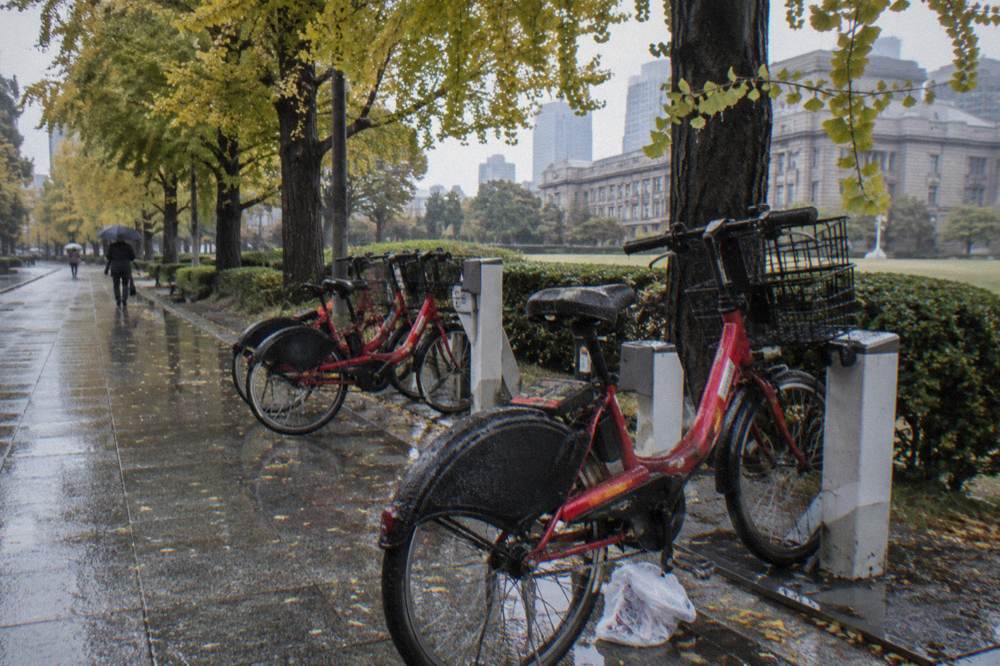
Route choice in rain is mostly about surface and shelter. The riverside paths, covered in detail in Sumida River cycling in Tokyo and Tokyo cycling routes, are wide, car-free and quick to dry, though exposed to wind when a front passes through. The backstreet networks of Yanaka and the downtown lanes are slower going but pass under shop awnings every few hundred metres, which is its own kind of shelter. What to avoid in rain is the big-signal arterial roads: more paint, more metal, more traffic spray. The full rules of the road, including sidewalk permissions and the blue-ticket regime introduced in April 2026, are laid out in Japan cycling rules for tourists.
What About Severe Weather And Sudden Downpours?
When a storm actually tracks toward the city the answer is simple: do not ride, cancel under the free-cancellation flag, and rebook, because tour operators and bike share systems can pause service on severe weather days and no booking is worth riding into a warning.
Between June and November the JMA issues warnings for approaching storms, and transport, including bike share systems, can shut down for a day. This is exactly the scenario free cancellation exists for, and it is why this guide keeps pushing flexible bookings for September and October dates.
Sudden downpours are the more common everyday case, especially in summer when heat builds through the afternoon and breaks in a short, violent shower. The right response is to stop, not to push on: convenience stores, station entrances and shrine grounds are everywhere in Tokyo and nobody objects to a cyclist waiting out twenty minutes of rain under an eave. Riders on guided tours should tell the guide, who will have sheltered a hundred times before and often reroutes to a covered stretch or a tea stop. The e-bike riders in the group simply switch the assist up once the road reappears.
There is a difference, worth naming, between rain and flood. Tokyo's storm drainage handles ordinary rain well, and riverside paths are built on levees that shed water fast. But the rivers themselves rise during heavy rain, and low paths along the Arakawa and Edogawa can close. Route reports from October 2026 note ongoing usability of the Arakawa Cycling Road with some detours on the Saitama side for works, so check current conditions if your independent route uses it. For the seasonal picture overall, including blossom timing and autumn colour, see best time to cycle in Tokyo.
Is A Rainy-Day Bike Tour Ever Better Than A Sunny One?
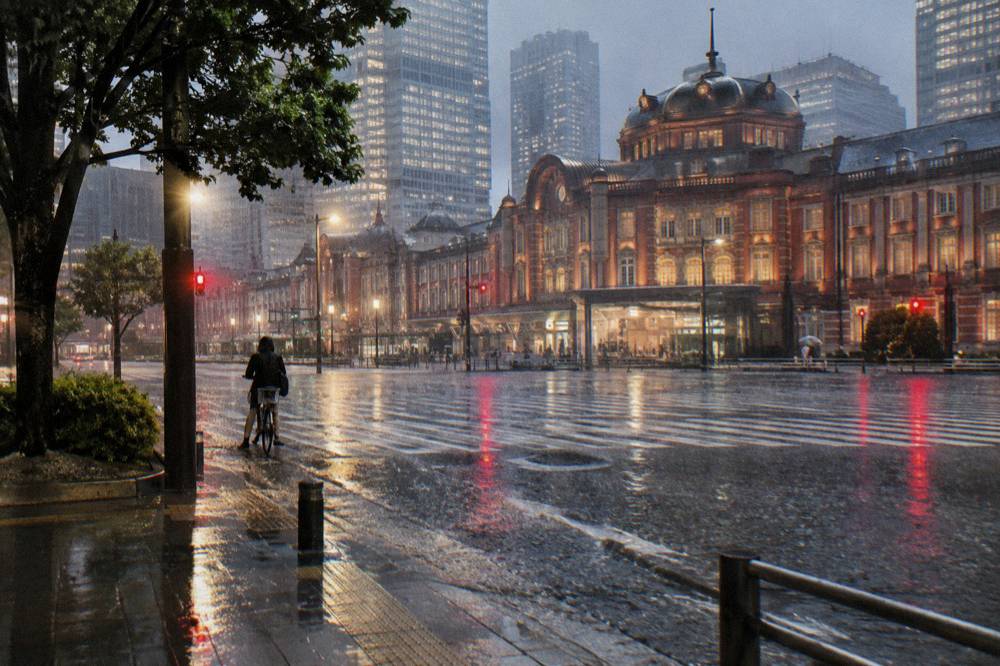
Often, yes: rain thins the crowds at Asakusa, the Palace moat and the Shibuya crossings, cools the summer air by several degrees, and turns the backstreets the tours favour into quiet, reflective versions of themselves, which is why wet-season departures still collect five-star reviews.
A 3-hour ride in light October drizzle with an empty temple forecourt can beat a sweltering August departure at 31.3 degrees mean daily maximum. The trade is comfort against access, and access is what most people come to Tokyo for.
The tours that suit a grey day best are the ones with stops built in. West-Side Cycling With Food Stops, from Koenji Station, runs 3 hours 30 minutes at from $106.89 per person, rated 5.0 across 223 reviews, and its food stops are natural rain shelters: you duck into a shop, eat something hot, and the weather outside becomes scenery rather than a problem. The total depends on group size, so treat the price as a from-figure and check the booking page. The group is capped at 8, small enough to duck under awnings together.
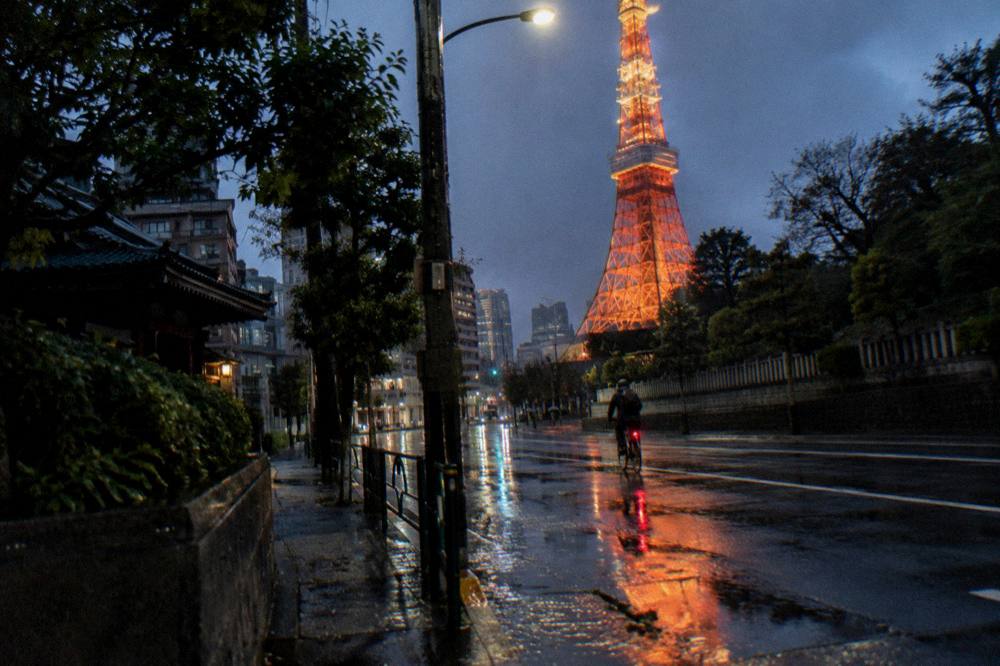
Photographers have their own reason to embrace the rain. Wet asphalt doubles the neon of a night ride, and the 2-Hour Night Lights Ride, from $55.06 per person and rated 5.0 across 31 reviews, sells the reflections of Shibuya and Tokyo Tower after rain as a feature rather than a flaw. Riders whose dates fall in the September to October wet window sometimes deliberately schedule the night option for after a rainy afternoon, when the streets are freshly washed and the lights are at their best. Night riding carries its own visibility rules, lights are legally required after dark, so follow the guide's setup rather than improvising.
The honest summary of the whole rain question is that Tokyo's climate rewards preparation, not avoidance. Book the tour with free cancellation, pack a shell and spare socks, choose a short or food-stop format if the forecast looks grim, and let the city deliver either sunshine or empty streets. Both outcomes have their advocates among the people who rode through both.
Common Questions About Cycling In Tokyo In The Rain
Do Tokyo Bike Tours Run In The Rain?
Yes, in light rain and drizzle nearly all of them do, including the Small-Group Long City Ride, rated 5.0 across 1,308 reviews, and the 3-Hour Highlights tour, rated 4.9 across 980 reviews. Only severe weather such as a severe weather warning stops departures, and in that case the free-cancellation flags most tours carry let you cancel without penalty.
What Is The Rainiest Month In Tokyo For Cycling?
October is the wettest month, averaging 234.8 mm of rain on the JMA 1991 to 2020 normals for the Tokyo station, followed by September at 224.9 mm. February is the driest at 56.5 mm, with January and December close behind.
What Should I Wear On A Bike Tour In Tokyo Rain?
A breathable rain shell over a synthetic base layer, quick-dry trousers, gloves with grip, a cap under the helmet, and spare socks sealed in a plastic bag. Do not carry an umbrella: riding while holding one is a fined offence under Tokyo's cycling rules.
Can I Cancel A Tokyo Bike Tour If It Rains?
Most tours covered here carry a free-cancellation flag on their booking pages, so you can cancel without penalty if the forecast turns. The Hidden Gems Ride carries free cancellation too: cancel up to 24 hours ahead for a full refund. Check the exact cutoff window on the specific tour page before booking.
Are E-Bikes Better Than Regular Bikes In Tokyo Rain?
E-bikes help on hills, bridges and in humid conditions by keeping your effort steady so you sweat less inside rain gear, but they do not improve braking or grip, which is what actually matters on wet streets. The 3-Hour Highlights tour lets each rider choose bike or e-bike at from $61.54 per person.
Is It Safe To Cycle In Tokyo When It Is Raining?
Light rain is manageable with earlier braking, slower cornering and care on painted lines and metal covers, and guided tours pace the group accordingly. When a severe weather warning is in force, do not ride; cancel under the free-cancellation flag and rebook for another day.