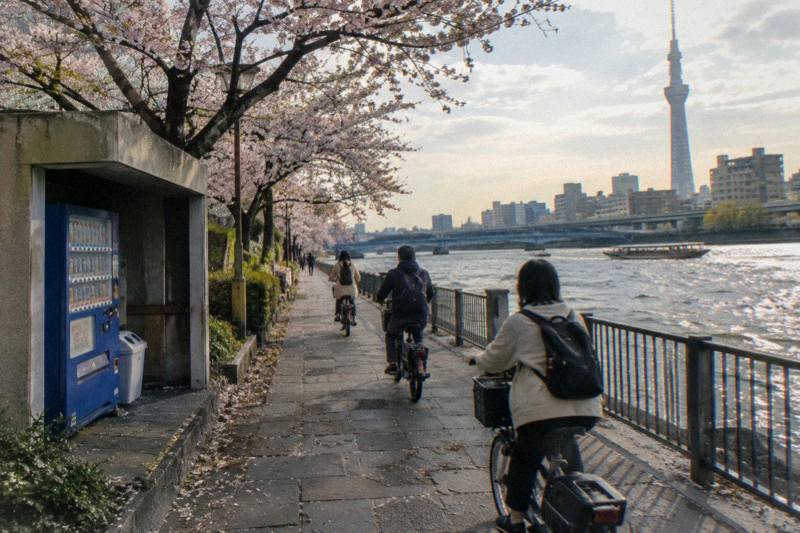
Arakawa Cycling Road: Flat Riverside Riding Near Tokyo
The Arakawa is Tokyo's biggest levee-riding canvas, a flat car-free corridor that local route guides describe as one of the longest riverside paths in the region. Here is what the road involves, how to reach it, and which guided rides cover comparable riverside terrain when you would rather follow a guide.
Short answer
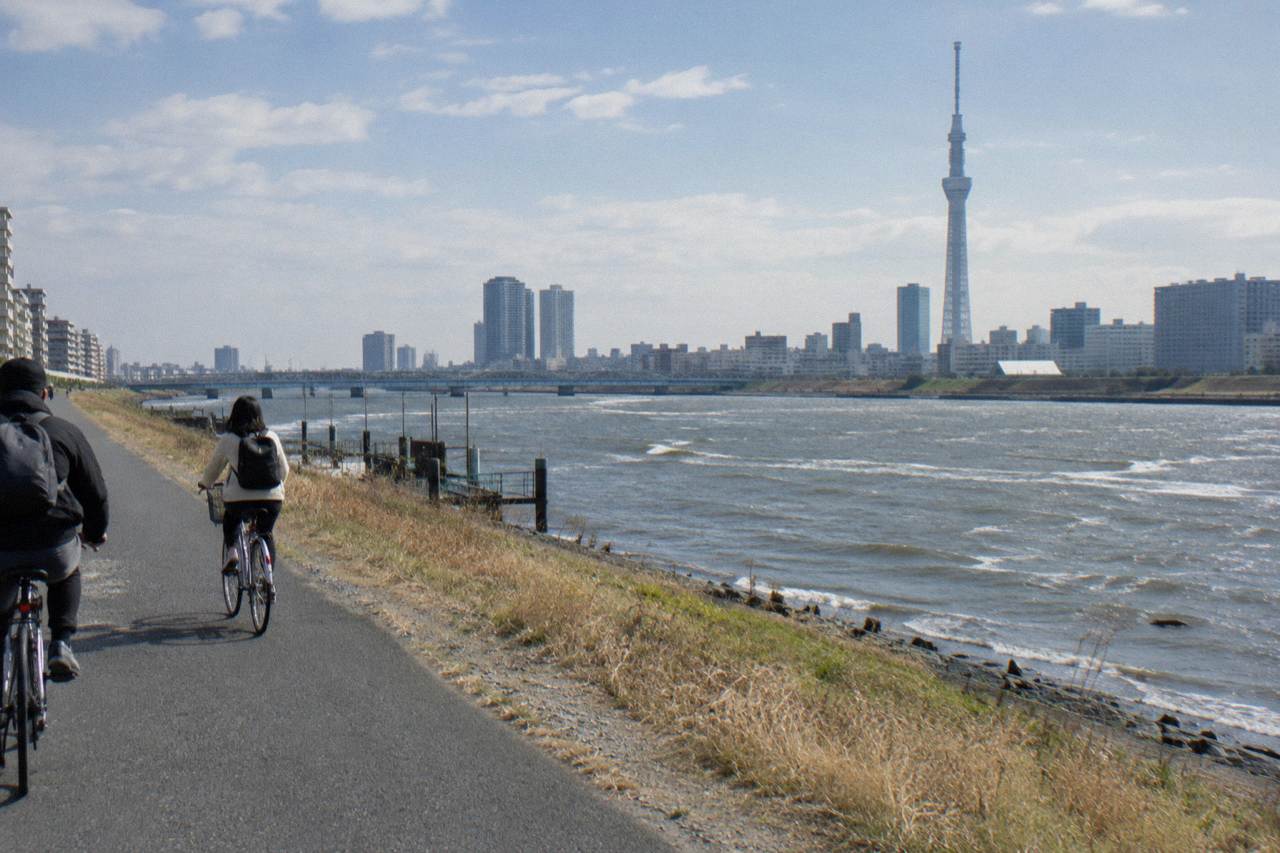
The Arakawa Cycling Road is a flat riverside levee path along the Arakawa river in northern and eastern Tokyo. Local route guides describe the full path at roughly 150 to 160 km, with a scenic segment of about 30 km from Ukima Park downstream to Kasai Rinkai Park on Tokyo Bay. No guided tour from this site rides it, so riders go self-guided or pick a Tokyo riverside tour instead.
Rivers change how a city rides. Tokyo's Arakawa is a wide, channelised river with broad grass levees on both banks, and on top of those levees runs one of the region's most rideable paths: flat, mostly separated from traffic, and long enough that you never have to turn around at the same point twice. Local route guides describe the Arakawa Cycling Road as roughly 150 to 160 km end to end, which makes it less a single route and more a corridor you sample. Riders who would rather have a guide often book a long city ride such as the Small-Group Long City Ride, a 6.5-hour outing rated 5.0 across 1,308 reviews.
This guide walks through what the road actually is, how far you can ride, how to reach it from central Tokyo, what the seasons do to the experience, and which guided tours come closest when you would rather not navigate the levee system alone.
What Is The Arakawa Cycling Road Near Tokyo?
The Arakawa Cycling Road is the informal name for the paved cycling and walking paths that run along the levees of the Arakawa river through Tokyo and into Saitama. It is flat, largely car-free and unlit in most sections, built for flood defence rather than sport, and it connects parks, bridges and river gates along both banks. Local route guides describe the full network at roughly 150 to 160 km.
The river itself is one of the majors of the Kanto plain. Tokyo keeps it inside high levees, and the crowns of those levees carry maintenance tracks that doubled, over decades, into cycling paths. That origin explains the riding character: wide sightlines, gentle curves, almost no gradient, and long stretches with no cross traffic. It also explains the limits. The path is shared with walkers and anglers, has few facilities directly on the levee, and drops down to road level wherever a bridge or gate crosses.
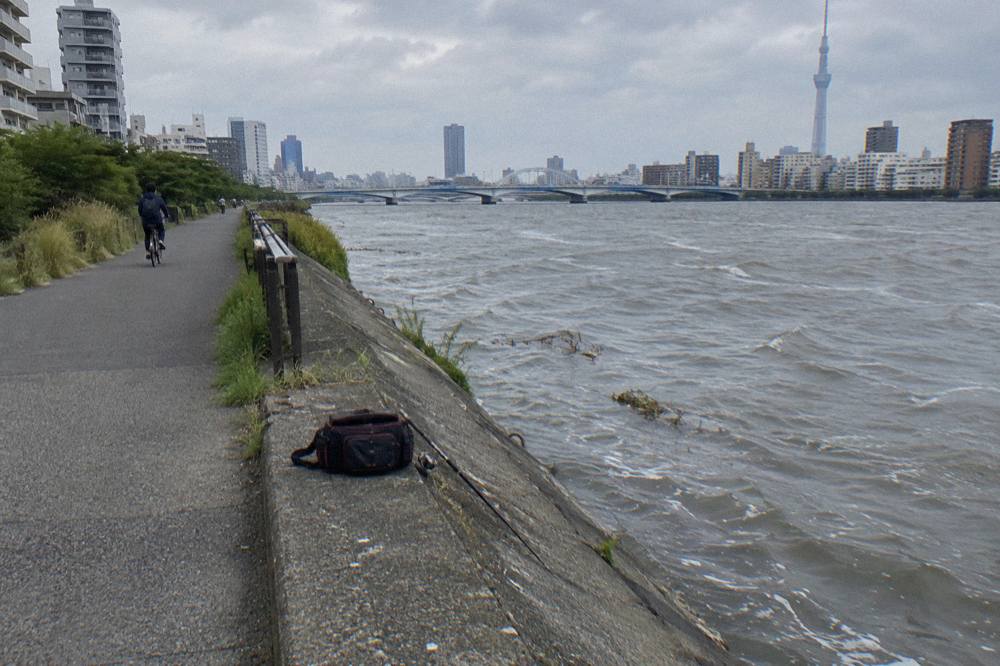
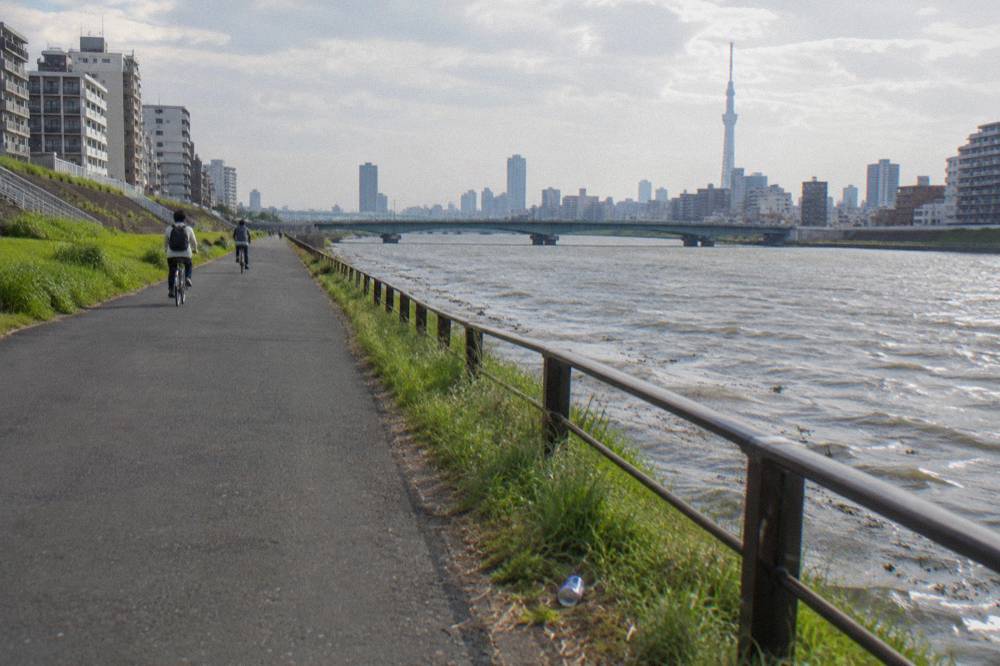
Route guides report that the most useful single segment for visitors runs about 30 km from Ukima Park in northern Tokyo downstream along the levees to Kasai Rinkai Park on Tokyo Bay. Along the way the path passes the red Akamizumon water gate and the blue Aomizumon structure at Iwabuchi, which regulate flow between the Arakawa and the Sumida river. Reported highlights also include long traffic-light-free sections and views toward the Tokyo Skytree where the two river corridors come close. Treat these descriptions as route reports rather than guarantees: conditions, detours and surface quality vary, and sections on the Saitama side have reported works with diversions in places.
For context on how Tokyo treats visiting cyclists generally, the official GO TOKYO guide to bicycles is the city tourism body's own summary of rules, share services and etiquette, and it applies on the levee just as it does on a shopping street.
“Fantastic, original tour through the back streets and parks as well as tourist sites of Shibuya. Tour guide was unusually articulate, thoughtful, and generous in sharing his insider's knowledge. I wish he did tours in every neighborhood of Tokyo! Thank you for an excellent afternoon.”
How Far Can You Ride Along The Arakawa Cycling Road?
Local route guides put the whole Arakawa path network at roughly 150 to 160 km, spanning Tokyo and Saitama. The segment most visitors actually ride runs about 30 km from Ukima Park to Kasai Rinkai Park on Tokyo Bay, flat almost the entire way. Casual riders commonly sample 10 to 20 km of it, turning back at a bridge or park that suits them.
Distance on the Arakawa is entirely self-serve. There is no marked start, no ticket, no official end. The levee is linear, so any out-and-back works, and bridge ramps give you exits at regular intervals if you want to bail onto a train line. Route guides note that the path links near Nakanoshima toward Sumida river routes, which opens longer mixed itineraries combining both rivers in one day for stronger riders.
A few practical reference points from route reports, all approximate:
| Segment | Rough distance | Character as described by route guides |
|---|---|---|
| Ukima Park to Akabane area | 5 to 8 km | Quiet levee, park access points, residential exits |
| Northern levees to Iwabuchi water gates | 10 to 15 km | Wide open levee, red and blue water gates as landmarks |
| Iwabuchi downstream toward the bay | 15 to 25 km | Long traffic-light-free sections reported, Skytree views |
| Full segment to Kasai Rinkai Park | about 30 km | Ends at a large bayfront park with a station nearby |
If a self-directed 30 km riverside day sounds like more planning than you want, the guided alternatives below cover Tokyo riverside and bayfront terrain with a leader who handles the route. Riders who would rather have a guide often book the Small-Group Long City Ride, the most reviewed trip on this site at 5.0 across 1,308 reviews. It spends six and a half hours on Tokyo streets with a group capped at five, from $106.89 per person, meeting at Tokyo Opera City Sankun Garden.
The three rides above span the formats most riders choose between: a full-day small-group immersion, a flexible 3 to 6 hour small-group option from $64.78 per person rated 4.9 across 212 reviews, and a 3 to 4 hour e-bike ride rated 4.9 across 895 reviews from $62.19 per person for riders who want the assist. None of them rides the Arakawa levee itself, but each touches the river-and-bay geography that makes the Arakawa appealing.
How Do You Get To The Arakawa Cycling Road From Central Tokyo?
The practical approach is to take a train toward the northern wards with a rented or shared bike, or rent near the river. Common access points include Ukima Park in the north and Kasai Rinkai Park at the bay end, both reachable from central Tokyo by rail. The levee has no single entrance, so pick your entry by which segment you want.
- City Bike Tours$32.39
- Private Tours$45.35
- Night Rides$55.06
- E-Bike Tours$61
- Day Trips By Bike$76
For riders using bike share, the arithmetic changes. Docomo Bike Share, one of Tokyo's main share systems, charges 165 yen per 30 minutes on its official Tokyo rate page, with a 1-day pass at 1,650 yen bought at a convenience store, or 2,200 yen with an IC card, valid until 23:59 the same day. Bikes must be returned to a share station, and the official Docomo Bike Share price page carries the current terms in English. Share stations cluster near stations and attractions rather than on levees, so share bikes suit city riding more than long levee runs.
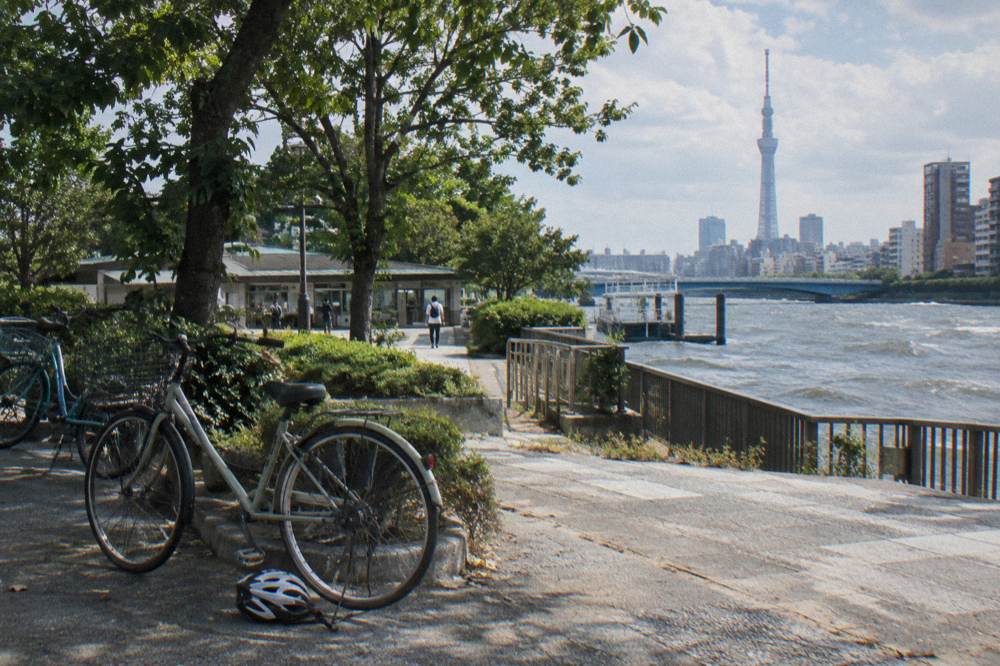
Riders who prefer everything arranged can skip the logistics question entirely with a guided riverside ride. The closest match on this site to Arakawa-style river riding is the Riverside E-Bike Ride, a 3-hour e-bike tour that focuses on Tokyo's riverside areas, from $85 per person, bike included, though its review pool of 10 is still small enough that no star claim is fair.
Do Any Guided Tokyo Tours Ride The Arakawa Itself?
No tour on this site rides the Arakawa levee. The guided options that come closest are rides built around Tokyo's other riverside corridors, mainly the Sumida river and the bayfront, plus riverside-flavoured city tours. If riding the actual Arakawa matters to you, self-guided is the way; if riverside scenery with a guide matters more, several tours deliver it.
The distinction is worth stating plainly because search results blur it. The Arakawa is a self-guided destination. What guided tours sell is the dense riverside geography of central Tokyo: the Sumida river paths around Asakusa and Ryogoku, canal districts, and bayfront parks. Riders coming from abroad often find a guided first day, then a self-guided levee day, gives them both the orientation and the open ride.
For the guided half of that plan, this site's related tour pages list full detail. The 6.5-hour guided small-group ride from Bicycle Tours Tokyo is the deepest option, and its riverside content pairs naturally with a levee day. Shorter options include the 2.5-Hour Central Short Ride from $51.82 per person, rated 5.0 across 25 reviews, for a compact taste of central river-adjacent streets.
For broader route planning beyond the Arakawa, the site's Tokyo cycling routes overview collects the main corridors in one place, and the Sumida river cycling guide covers the central-Tokyo river that guided tours actually use. Riders weighing electric assist for a two-river day can start with the Tokyo e-bike tour guide.
When Is The Best Season To Ride The Arakawa Levee?
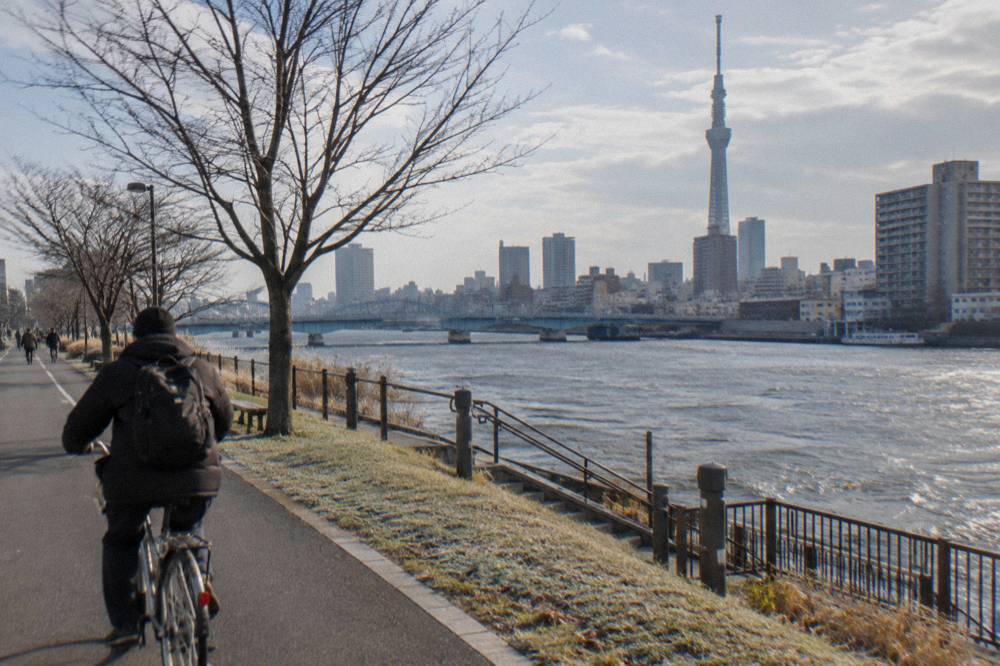
The most comfortable riding windows on Tokyo riversides are spring, from March to May, and late autumn, from late October to November. JMA 1991 to 2020 normals for the Tokyo station put the wettest months in September and October and the hottest mean temperatures in August, so midsummer and the wet tail end of summer both demand caution. Winter is cold but dry and often fine.
The numbers behind that advice come from the Japan Meteorological Agency's 30-year normals for the Tokyo station. They reward attention: October, at 234.8 mm of rain, is actually wetter than the rainy-season month of June at 167.8 mm, and September follows at 224.9 mm. The driest months are February, December and January, each under 60 mm, with January mean daily highs of 9.8 degrees and lows of 1.2 degrees: cold, but very rideable with gloves and layers. More of these guides are collected on Tokyo Bike Tours.
| Month | Mean temp C | Mean daily max C | Precipitation mm | Riding note |
|---|---|---|---|---|
| January | 5.4 | 9.8 | 59.7 | Cold, dry, clear skies common |
| March | 9.4 | 14.2 | 116.0 | Blossom season begins late month |
| April | 14.3 | 19.4 | 133.7 | Prime riding month |
| June | 21.9 | 26.1 | 167.8 | Rainy season, humid |
| August | 26.9 | 31.3 | 154.7 | Hot, mean daily max over 31 |
| October | 18.0 | 22.0 | 234.8 | Wettest month, heavy rain tail |
| November | 12.5 | 16.7 | 96.3 | Crisp, dry, excellent |
Spring adds a specific draw. JMA records Tokyo's 2026 cherry first bloom on 19 March, five days earlier than the 24 March normal, with full bloom on 28 March against a 31 March normal. River levees are among the best blossom-viewing corridors in the city precisely because the trees run in unbroken lines along the water. For riders planning around that window, the site's best time to cycle in Tokyo guide breaks the calendar down month by month.
Arakawa Cycling Road Distances By Segment
Distances as described by local route guides
What Does It Cost To Ride The Arakawa Cycling Road?
The path itself is free and public, so your costs are the bike and the journey. Verified share pricing puts Docomo Bike Share at 165 yen per 30 minutes or a 1,650 yen day pass from a convenience store. Guided riverside alternatives run from $51.82 to $106.89 per person depending on length and format. No tour from this site charges for the Arakawa because none rides it.
The share-bike route is the cheapest way onto riverside paths, with one caveat: share bikes must return to a station, and stations sit near stations and attractions, not mid-levee. That makes share bikes ideal for the bayfront end at Kasai Rinkai Park or short riverside hops, and awkward for a 30 km levee run, which is why many levee riders rent a bike for the day or bring one on the train.
| Option | Cost basis | What it includes | Best for |
|---|---|---|---|
| Docomo one-time use | 165 yen per 30 min | E-assist share bike, port-to-port | Short riverside hops |
| Docomo 1-day pass | 1,650 yen, convenience store | Unlimited rides to 23:59, station returns | A day of station-to-station riding |
| Riverside E-Bike Ride | from $85 per person | 3 hours, e-bike, guide | Guided riverside focus |
| Flexible 3-6 Hour Small-Group Ride | from $64.78 per person | 3 to 6 hours, bike, guide, group max 8 | Budget small-group option |
| Small-Group Long City Ride | from $106.89 per person | 6.5 hours, bike, helmet, guide, group max 5 | Full-day immersion |
Among the guided options, the Local Life E-Bike, Starts Near Station tour is another mid-price choice at from $63.48 per person, rated 4.9 across 753 reviews, meeting near a station which spares you the hardest part of Tokyo ride logistics. Food and drinks are self-pay at shops along the way.
What Rules Apply To Cyclists On Tokyo Riversides?
Tokyo's citywide bicycle rules apply on the Arakawa: ride on the left, keep to the path side designated for cycling where signed, yield to pedestrians on shared levee sections, and carry liability insurance as the Tokyo ordinance requires. Since April 2023 helmet use is an effort obligation for every age, with no fine. From 1 April 2026 a blue-ticket system applies to riders aged 16 and over.
The levee's shared character is the main behavioural issue. Walkers, joggers and anglers use the same crown, and the polite pattern riders report is simple: announce yourself, slow for pedestrians, and pass wide. The enforcement backdrop hardened recently. Under the traffic violation notice system in force since 1 April 2026, fixed fines for riders 16 and over include 12,000 yen for holding a phone while riding, 6,000 yen for ignoring a signal or riding against traffic, 5,000 yen for riding without a light at night or with an umbrella in hand, and 3,000 yen for riding two abreast. Officers normally give guidance and a warning first, with tickets aimed at dangerous or repeated violations. Overseas visitors are explicitly included, as the Tokyo police English traffic rules page confirms.
Insurance is the quiet requirement visitors most often miss. Tokyo ordinance has required cyclists to hold liability coverage since 1 April 2020, and rental businesses must insure the hirer's use and tell renters what is covered. That means a rented or tour bike comes with the operator's cover, but a borrowed or share bike may rely on a personal policy, and home or travel policies with a personal liability rider can count. The site's Japan cycling rules for tourists guide covers the full rule set in plain language.
Is The Arakawa Cycling Road Good For Beginners And Families?
Yes, with supervision. The levee is flat, car-free along most sections and forgiving of slow, wobbly riding, which is exactly what beginners and children need. The cautions are shared paths with pedestrians, long unshaded stretches in summer, and few facilities on the levee itself, so carry water and plan exits. Family groups with young or hesitant riders should sample short segments near parks.
“Amazing fun and enjoyed the whole experience. Saw the quiet streets of Tokyo to the parts you would only find with a knowledgeable guide.”
Families comparing formats should know that guided city tours set their own pace and group caps, and several welcome newer riders comfortably. The Flexible 3-6 Hour Small-Group Ride caps groups at eight and lets the length flex, which suits families with mixed stamina, while the Hidden Gems E-Bike, 3-4 Hours ride from $62.19 per person, rated 4.9 across 895 reviews, uses e-bikes that flatten Tokyo's few climbs and its bridge ramps. For younger children, the site's Tokyo bike tour with kids guide addresses child seats and pacing directly.
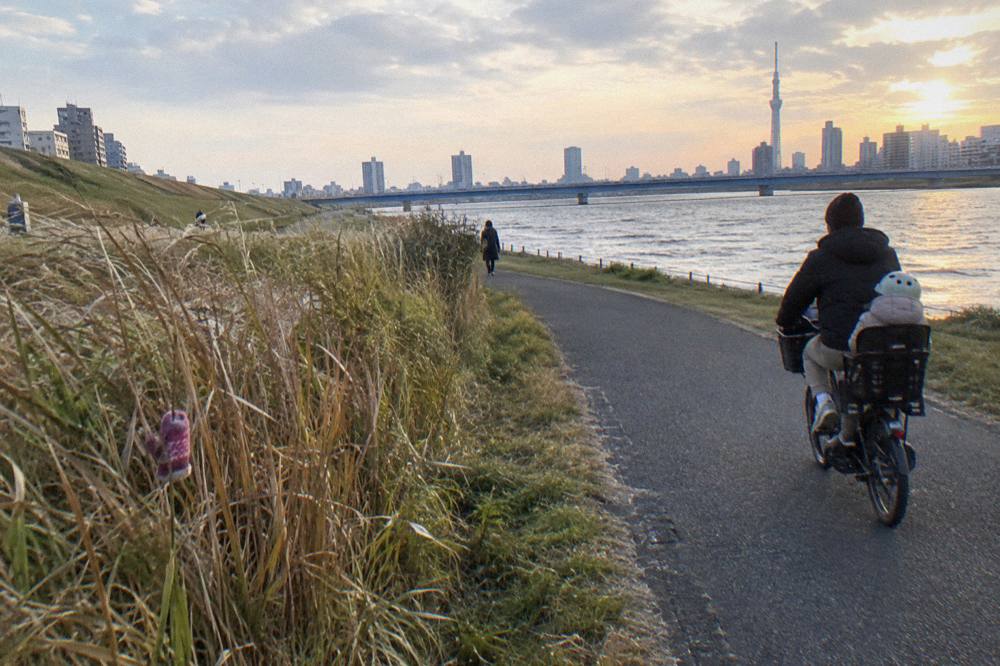
For the levee itself, beginners report the best results entering at a park, riding one direction for 20 to 30 minutes, and turning back. The path never gets technical: no traffic merges, no gravel, no gradients worth naming. What it does not have is hand-holding, so if your group includes a nervous rider, a guided first day builds the skills and the confidence for a self-guided levee day after.
Common Questions About The Arakawa Cycling Road
How Long Is The Arakawa Cycling Road?
Local route guides describe the full levee path network at roughly 150 to 160 km across Tokyo and Saitama. The segment most visitors ride runs about 30 km from Ukima Park downstream to Kasai Rinkai Park on Tokyo Bay, and casual riders commonly sample 10 to 20 km of it.
Do Any Guided Tours Ride The Arakawa Cycling Road?
No tour on this site rides the Arakawa levee. The closest guided match is the Riverside E-Bike Ride, a 3-hour e-bike tour of Tokyo's riverside areas from $85 per person, with bike and guide included. City and e-bike tours cover the Sumida river and bayfront corridors instead.
How Do I Get To The Arakawa Cycling Road From Central Tokyo?
Take a train toward the northern wards or the bayfront. Common entry points are Ukima Park in the north and Kasai Rinkai Park at the bay end, both reachable from central Tokyo by train. Bring a bike on the train in a rinko bag, or use share bikes near the bayfront end.
Is The Arakawa Cycling Road Flat?
Yes. The path runs along river levees built for flood defence, so it is essentially level for its whole length, with only short ramps where it drops to road level at bridges and gates. That flatness is the main reason beginners and families ride it.
When Is The Best Time Of Year To Ride The Arakawa?
Spring from March to May and late autumn around late October to November are the most comfortable windows. JMA 1991 to 2020 normals for the Tokyo station show September and October as the wettest months and August as the hottest, while winter is cold but dry and often clear.
Are Helmets Required On The Arakawa Cycling Road?
Helmets are an effort obligation for every cyclist of any age in Japan since April 2023, meaning riders should wear one but face no fine. Most guided tours from this site include a helmet with the bike; check the tour page for details.