Sumida River Cycling In Tokyo: Bridges, Terraces And Skytree
The Sumida is the river that stitches old Tokyo to the new bayfront, and a bike is the fastest honest way to follow it from temple streets to tower glass.
Short answer
The Sumida river runs from central Tokyo past Asakusa, the Skytree and down to the bay, and riverside terraces make it one of the flattest, most forgiving rides in the city. A guided option such as the Olympic Sites Bay Ride covers the waterfront in 3 hours from $48.59 per person, while the classic riverside loops run 3 to 6 hours and from about $61 per person.
The Sumida river is the reason Tokyo looks the way it does on a map: everything old clustered on its terraces, everything new stacked along its banks, and a ribbon of water connecting the two. Route guides describe a rideable stretch from the Asakusa side downstream toward Ryogoku, with Senso-ji streets at one end and Skytree looming over the middle, and the bay paths of Odaiba waiting at the far end. It is flat, it is mostly separated from traffic, and it rewards a bicycle more than any other mode of transport in the city.
This page covers the practical side of Sumida river cycling: where the rideable paths sit, which guided tours actually follow the water, what the seasons do to the experience, and the road rules that apply to visitors. The featured option here is the Olympic Sites Bay Ride, a 3-hour guided loop from $48.59 per person that takes in the Tokyo Bay waterfront the river feeds into, with bike, helmet and guide included and free cancellation on the listing. If you would rather compare three strong picks side by side, that comparison comes early.
Where Can You Ride Along The Sumida River In Tokyo?
The rideable spine runs along the river terraces between the Asakusa area and the downstream wards, with route guides describing a stretch of roughly 4 km from Asakusa toward Ryogoku that passes Senso-ji approaches and Skytree views, and the path network continuing toward the bay. The river itself is the flattest corridor in the city, which is why so many guided routes borrow it.
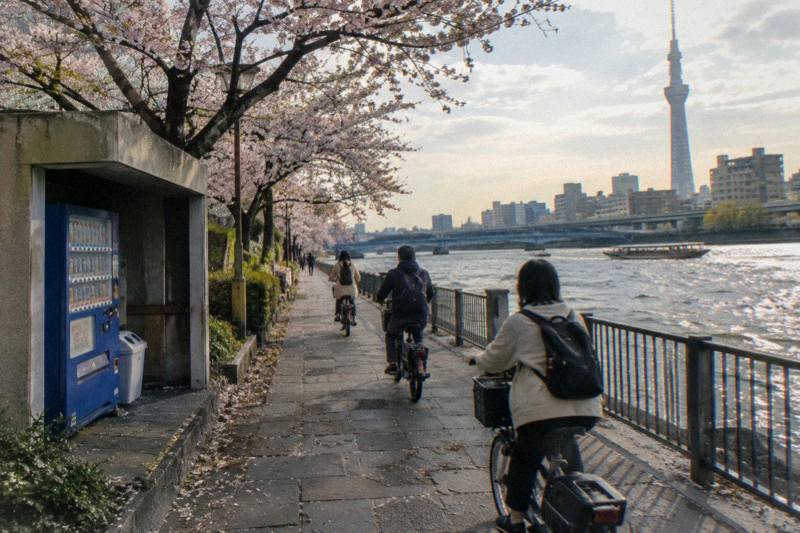
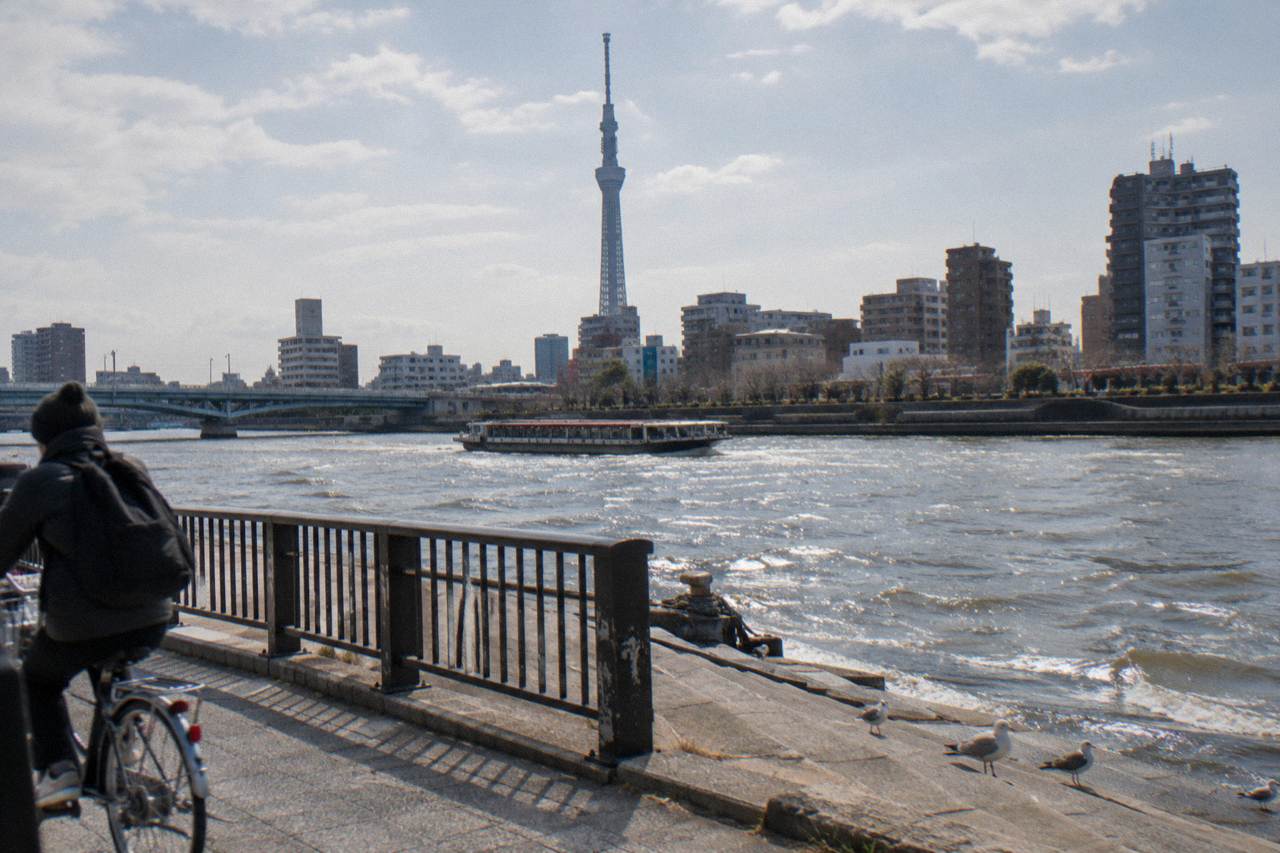
The Sumida is tidal, bridged and banked by stepped terraces, and the cycling sits on those terraces rather than on the roadway. Route guides describe the Asakusa end as the natural start: you leave the temple quarter, drop onto the waterfront, and ride with the river on one side and the low skyline of the old wards on the other. Skytree appears early and stays with you for a long stretch, which is one reason photographers gravitate to this route in the first hour after sunrise and the hour before sunset.
Downstream, the river widens and the character shifts from wooden-era lanes to warehouses, sports venues and, eventually, the artificial islands of the bay. The official visitor guide from the Tokyo tourism board covers cycling basics for visitors and confirms the riverside and bayfront paths as a linked network, so a rider who starts on the Sumida can, with a little planning, finish on the Odaiba waterfront. The Odaiba and Tokyo Bay cycling guide picks up the story exactly where the river hands you to the sea.
A few practical notes for the path itself. The terraces are shared with pedestrians, and the sidewalk rules described later in this page apply: ride slowly, keep to the river side, and expect walkers near the bridges and the sightseeing piers. Pier traffic around Asakusa thickens midday, and the route guides describe the quayside near the Sakurabashi bridge area as a place where dismounting for twenty meters saves everyone friction. None of this makes the route difficult, it simply makes it a shared space rather than a velodrome.
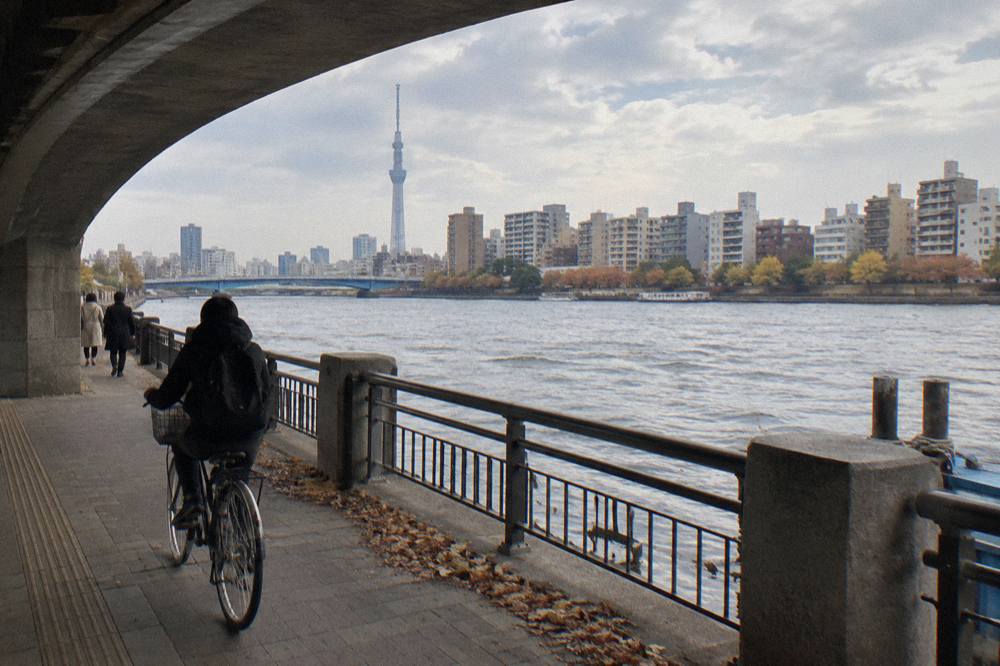
If you are riding independently rather than with a guide, the orientation problem is minimal: pick up the river anywhere along its eastern half and follow the water. The bigger decision is whether to ride alone or hand the navigation to someone who knows which quay crossings connect, which is what the next section settles.
Which Guided Bike Tours Follow The River And The Bay?
Three styles of guided ride cover this water: long small-group loops that weave the river into a full city circuit, short e-bike highlights rides that touch the waterfront between palace and old town, and the bayfront Olympic Sites Bay Ride, a 3-hour tour from $48.59 per person that starts in Tokyo and explores the waterside venues the river feeds. Most river-curious visitors land on one of these three.
The long option is the Small-Group Long City Ride 30 Minutes from Bicycle Tours Tokyo: from $106.89 per person, rated 5.0 across 1,308 reviews, capped at 5 riders, meeting at Tokyo Opera City Sankun Garden, with bike, helmet and guide included and free cancellation per the listing. It is the most reviewed ride of this style anywhere in the city, and the small cap means the guide can thread river terraces and backstreets at conversational pace.
Between those poles sit the medium-weight rides. The comparison below lays out the three tours in the selection band plus the other river-relevant options, using only the figures from each tour's booking page.
| Tour | Style | Duration | Price per person | Group cap | Reviews |
|---|---|---|---|---|---|
| Olympic Sites Bay Ride | Bay and Olympic venues | 3 hours | from $48.59 | 15 | new listing |
| Small-Group Long City Ride | Full city with river sections | 6 hours 30 minutes | from $106.89 | 5 | 5.0 from 1,308 |
| Hidden Gems E-Bike, 3-4 Hours | E-bike highlights loop | 3 to 4 hours | from $62.19 | 6 | 4.9 from 895 |
| 3-Hour Highlights, Bike or E-Bike | Choose your bike | 3 hours | from $61.54 | Not stated | 4.9 from 980 |
| Riverside E-Bike Ride | River-focused e-bike | 3 hours | from $85 | 8 | 10 reviews |
The Riverside E-Bike Ride deserves its line: it is the one tour on the books whose entire concept is the river corridor, an e-bike loop from TRB BIKE TOUR with guide and bike included, from $85 per person, currently carrying 10 reviews, too few for a star claim but a genuine sign the format has takers. Read more about the electric option in the Tokyo e-bike tour guide if the assist question is your main variable.
One honest caveat on the word "river" in tour titles. Many full-city tours cross the Sumida and ride a terrace for a stretch without the river being the theme, and that is fine, it is how a good city loop works. If the water itself is the point, the bay ride and the riverside e-bike loop are the two that put it at the center, and the long small-group ride is the one that gives it the most minutes.
How Hard Is Sumida River Cycling For A Beginner?
It is about the gentlest introduction to urban cycling in Tokyo: the river corridor is flat, the terraces separate you from traffic, and a 3-hour guided pace covers ground without fitness demands. The main challenges are shared-space courtesy near Asakusa and bridge crossings, not climbs, and e-bike options reduce even the modest effort to almost nothing.
Riders who have never sat on a bike in a big Asian city usually picture chaos. The Sumida delivers the opposite. There are no meaningful gradients, the surface is paved, and the moments that demand judgment are few: pier crowds, bridge ramps and the occasional terrace step where carrying the bike for three meters is normal practice. Guides on the small-group rides set a pace the listing describes as conversational, and a group cap of 5 or 6 keeps the guide close enough to call out every decision point.
The Small-Group Long City Ride is the deepest version of this hand-holding, and its 1,308-review pool at 5.0 is the strongest evidence anywhere on this site that first-timers finish it happy.
If six and a half hours sounds like more saddle time than your first day warrants, the shorter routes carry the same supportive structure. The beginners' Tokyo bike tour guide breaks the confidence question down in detail, including what to do about the sidewalk-versus-roadway decision that confuses most newcomers.
For riders who want zero pedaling pressure, the e-bike paths are wide. The 3-Hour Highlights, Bike or E-Bike tour lets each rider choose regular or electric at the same from-price of $61.54 per person, rated 4.9 across 980 reviews, meeting at the Statue of Commodore Perry. One inclusion to note from the listing: helmets rent on that tour for 1000 yen cash on the day, they are not bundled, which matters if you pack light.
What Will You See Between Asakusa And Skytree?
The upstream stretch packs the densest sightseeing of any riverside ride in Tokyo: the Senso-ji temple quarter and its lantern-hung approach streets, the Sumida's bridge series, the terrace gardens, and Skytree rising over the east bank, with route guides describing continuous river views once you drop off the temple streets onto the water.
Start in Asakusa and the first kilometers are old Tokyo at walking-bike speed: temple gates, five-story pagoda silhouettes, and souvenir lanes that open unexpectedly onto the water. The Asakusa bike tour guide covers this end of the river in depth, including which approach streets are calm enough to ride and where the crowds make walking the bike the polite choice.
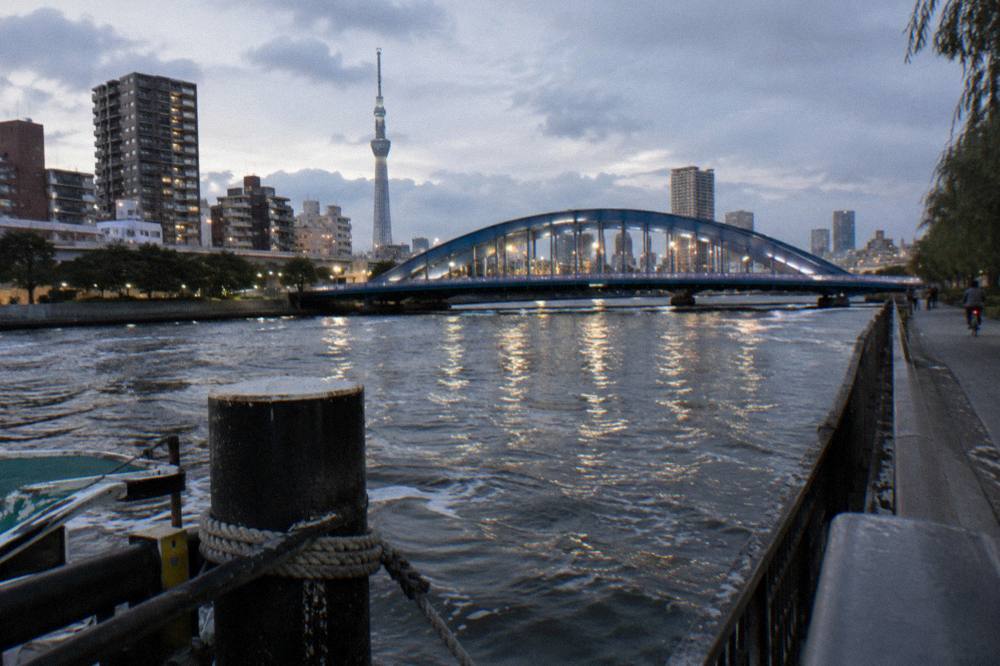
The bridges are the quiet highlight. The Sumida is crossed by more than a dozen road and rail bridges on its way to the bay, each with a different silhouette, and the terrace level gives you a low, waterline view of them that pedestrians on the upper decks never get. Route guides describe photographers favoring the early morning light on the upstream bridges, when the tour boats have not yet started their shuttle runs and the terraces are close to empty.
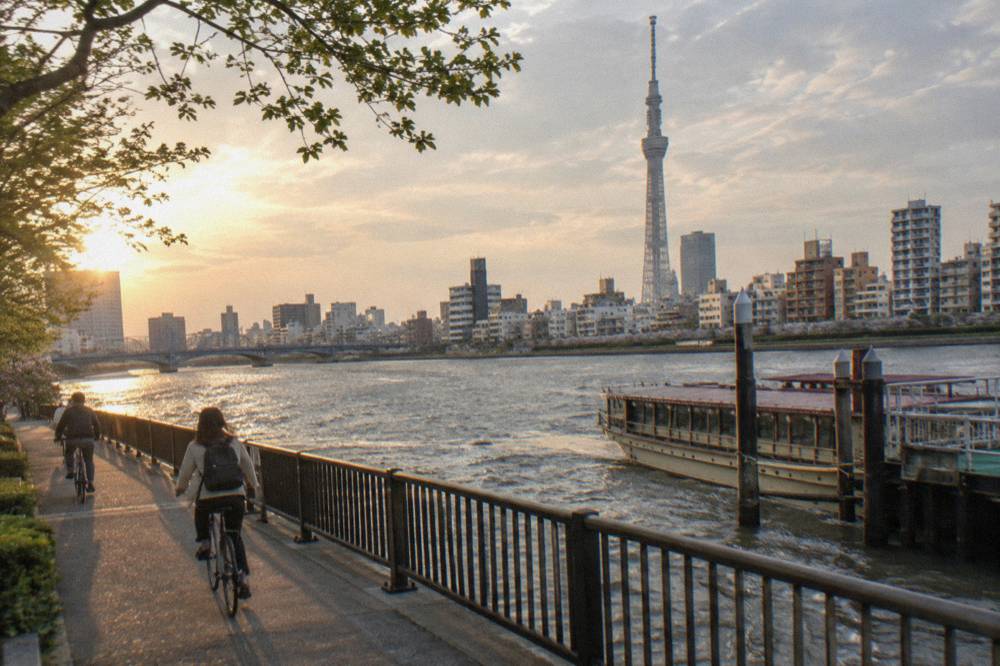
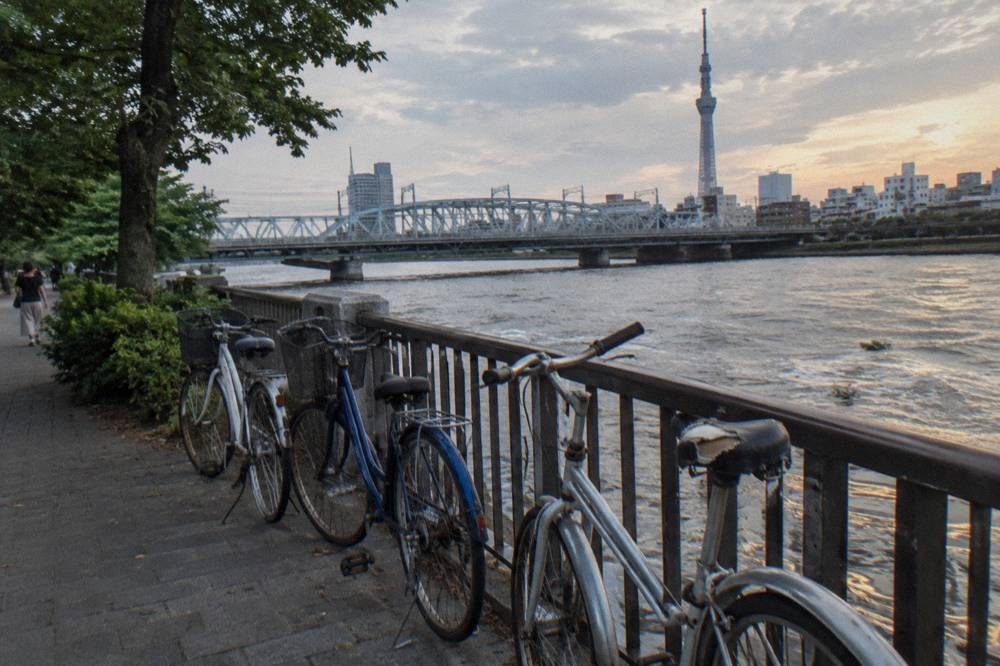
Skytree changes the geometry of the ride. Past the Azumabashi area the tower sits directly across the river, and for the next stretch every terrace turn frames it differently. The commercial complex at its base is a standard rest stop, and the riverside parks just downstream make a better picnic pause than the mall terraces, which fill quickly on weekends. Route guides describe the downstream continuation toward Ryogoku passing the sumo quarter's muted streets, a contrast that earns its few minutes even on a tight loop.
Food along the corridor is uneven but real: tempura and soba institutions near Asakusa, convenience stores everywhere, and the occasional riverside stand. If eating is the point rather than a pause, the Tokyo food bike tour guide covers the rides built around stops rather than sights, including the West-Side Cycling With Food Stops tour from DIG Tokyo Tours, 3 hours 30 minutes from $106.89 per person, rated 5.0 across 223 reviews, meeting at Koenji Station.
When Is The Best Season To Ride The Sumida River?
The two best windows are late March into April for the cherry blossoms and October into November for cool, dry air and late sunsets; JMA 1991 to 2020 normals for the Tokyo station put March first bloom near 24 March, and October and September as the wettest months at 234.8 mm and 224.9 mm, which argues for autumn over early autumn rain. Winter is the underrated third choice.
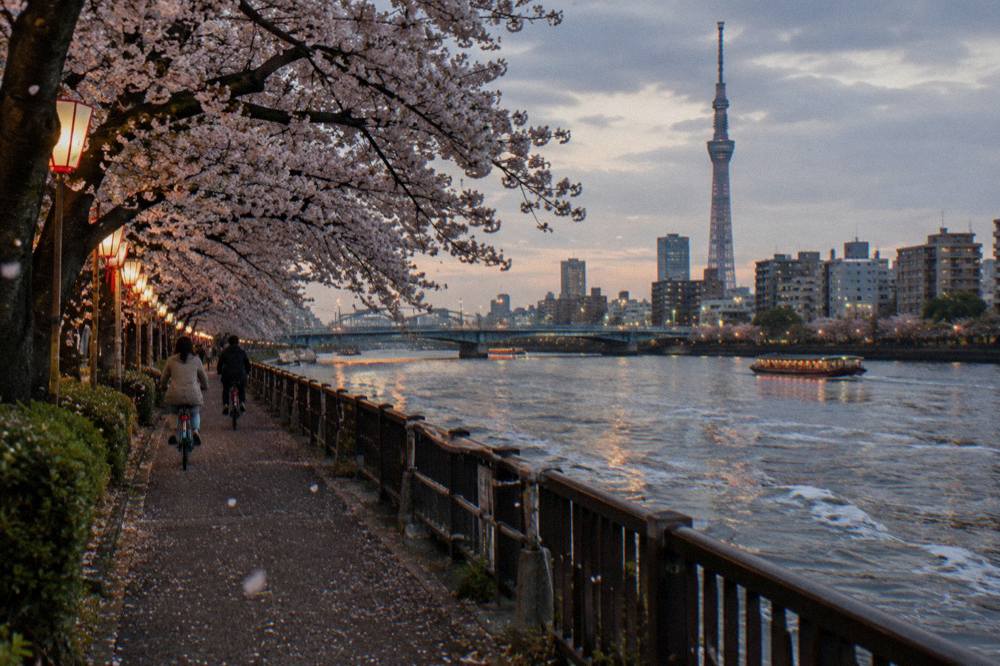
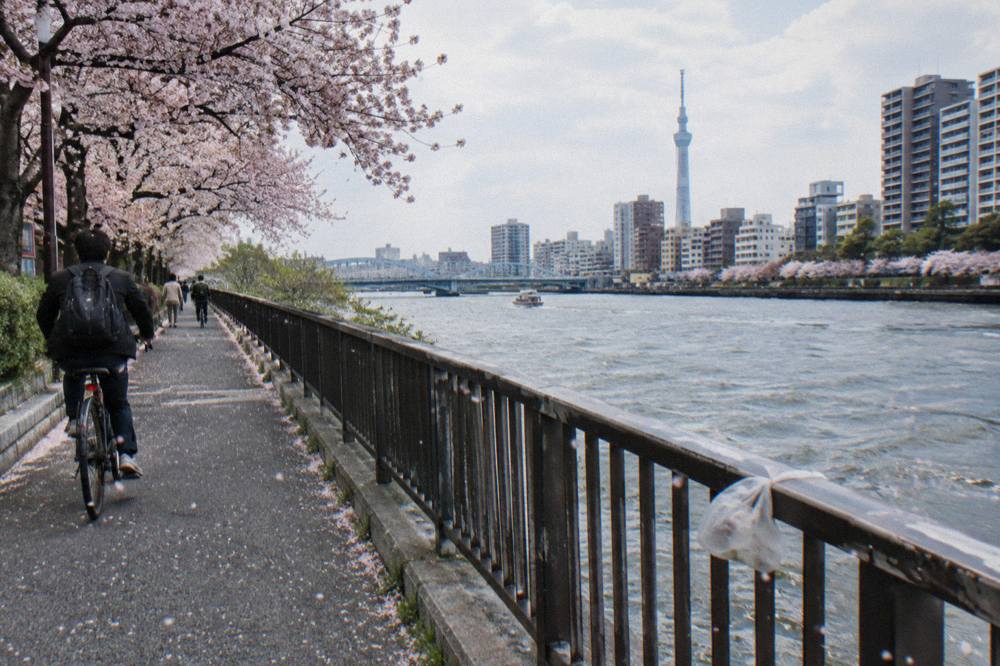
The blossom season is the famous one, and the river is one of the places the fame is earned: the Sumida terraces are lined with cherry trees, and the petal fall onto the water is the postcard. The Japan Meteorological Agency recorded Tokyo's 2026 first bloom on 19 March, five days earlier than the 24 March normal, with full bloom on 28 March, so planning a ride for the last week of March carries real odds. The cherry blossom bike tour guide covers the blossom-specific rides.
The numbers behind that advice, from the JMA climate normals for the Tokyo station:
| Month | Mean temp C | Mean daily max C | Precipitation mm |
|---|---|---|---|
| Jan | 5.4 | 9.8 | 59.7 |
| Feb | 6.1 | 10.9 | 56.5 |
| Mar | 9.4 | 14.2 | 116.0 |
| Apr | 14.3 | 19.4 | 133.7 |
| May | 18.8 | 23.6 | 139.7 |
| Jun | 21.9 | 26.1 | 167.8 |
| Jul | 25.7 | 29.9 | 156.2 |
| Aug | 26.9 | 31.3 | 154.7 |
| Sep | 23.3 | 27.5 | 224.9 |
| Oct | 18.0 | 22.0 | 234.8 |
| Nov | 12.5 | 16.7 | 96.3 |
| Dec | 7.7 | 12.0 | 57.9 |
Read plainly: summer is hot and humid with August means of 26.9 C and daily maxima averaging 31.3 C, the September-October pair is the wettest stretch of the year, and the December-February window is dry, cool and bright with means between 5.4 and 7.7 C. Winter riders trade blossom views for empty terraces, low glare off the water, and the best chance of a clear Fuji-frame from the upper bridges. The fuller month-by-month argument sits in the best time to cycle in Tokyo guide.
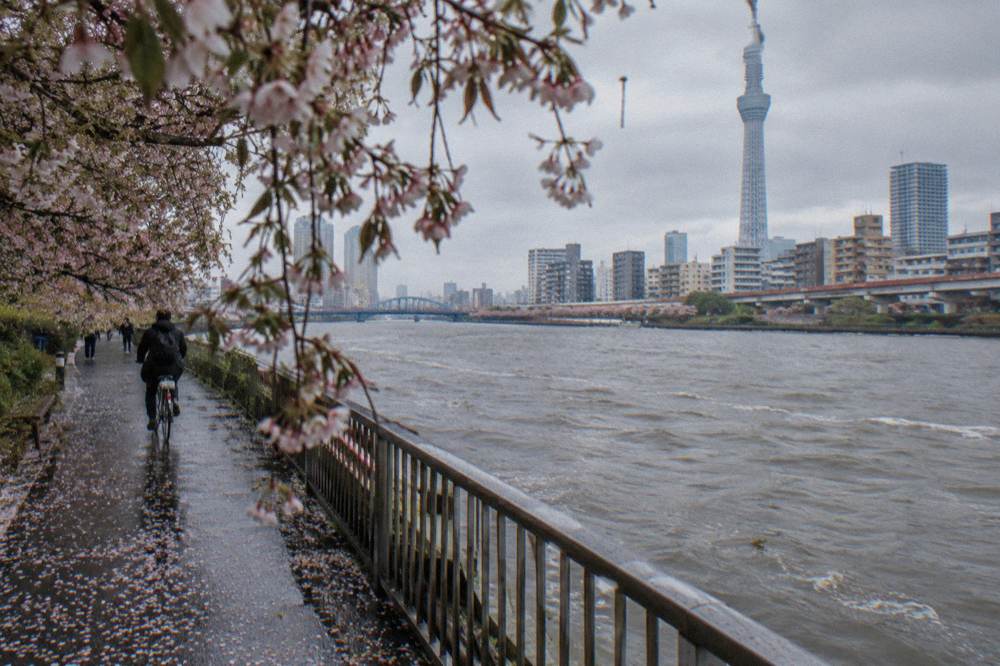
For a river ride specifically, the one season to approach with eyes open is the rainy-season month of June at 167.8 mm and the wet late summer. Tours run in rain, and the cycling in rain guide covers what to expect, but the terraces lose their charm in a downpour and the listings' free-cancellation terms are the traveler's friend in that window.
Which Rules Apply To Visitors Cycling The Sumida Path?
The short list: ride on the left of the roadway by default and use terraces and sidewalks only where signed or permitted, carry liability insurance as the Tokyo ordinance requires, wear a helmet as an effort obligation of every age, and know that since 1 April 2026 a blue-ticket system of fixed fines applies to riders 16 and over, including overseas visitors.
The Tokyo Metropolitan Police maintain the authoritative pages. The core rules, roadway riding on the left and the conditions for sidewalk use, are on the MPD bicycle rules page, and the English summary for visitors is on the MPD English traffic rules page, which states plainly that cyclists will be issued tickets for traffic offences. On the shared river terraces this collapses to one instruction: pedestrians have priority, ride at their pace when passing, and stop if the path is crowded.
The fixed fines are worth knowing, not because visitors habitually break rules, but because the amounts surprise people. Selected verified figures from the MPD rule book:
| Violation | Fixed fine (yen) |
|---|---|
| Holding a phone to talk or watch while riding | 12,000 |
| Ignoring a traffic signal | 6,000 |
| Riding against traffic | 6,000 |
| No light at night | 5,000 |
| Riding two abreast | 3,000 |
| Carrying a passenger | 3,000 |
Officers normally give guidance and a warning first, and tickets target malicious or dangerous violations, per the MPD's own description of the system. Drunk cycling is a separate criminal matter, not a blue ticket.
Helmets are an effort obligation for every age since April 2023, with no fine attached, though the MPD reports that 63.5 percent of cycling deaths in Tokyo between 2021 and 2025 involved fatal head injuries and that the fatality rate without a helmet is 2.3 times higher. Most tours in this article include one; the two TRB BIKE TOUR highlights rides rent helmets for 1000 yen cash instead. Insurance has been compulsory for cyclists in Tokyo since 1 April 2020, and rental businesses, including tour operators, must insure the hirer's use and tell renters what is covered, which means a guided tour handles this for you.
Should You Ride Independently Or Take A Guided Sumida Tour?
Independent riding along the Sumida is genuinely easy thanks to bike-share pricing from 165 yen per 30 minutes on the official Docomo system, but a guided tour adds the insurance, the helmet, the route judgment and the commentary for a from-price of roughly $48 to $107 per person, and on a river corridor the commentary is what turns bridges into stories.
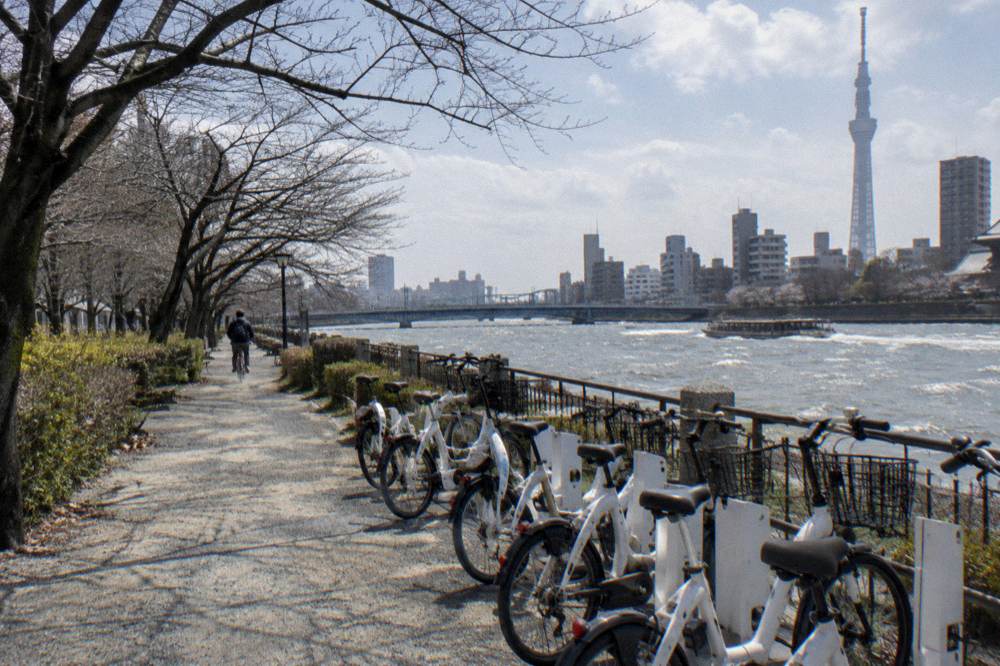
The share-bike case is real. The official Docomo Bike Share price page for Tokyo lists one-time use at 165 yen for the first 30 minutes with extensions at 165 per further 30 minutes, and a 1-day pass at 1,650 yen bought at a convenience store, valid until 23:59, requiring an SMS-capable phone; the official Docomo price page carries the current terms. Bikes must return to a designated station, and registration needs a smartphone and a credit card. HELLO CYCLING runs a parallel network with prices set per prefecture and vehicle in its app. The Tokyo bike share guide compares the systems properly.
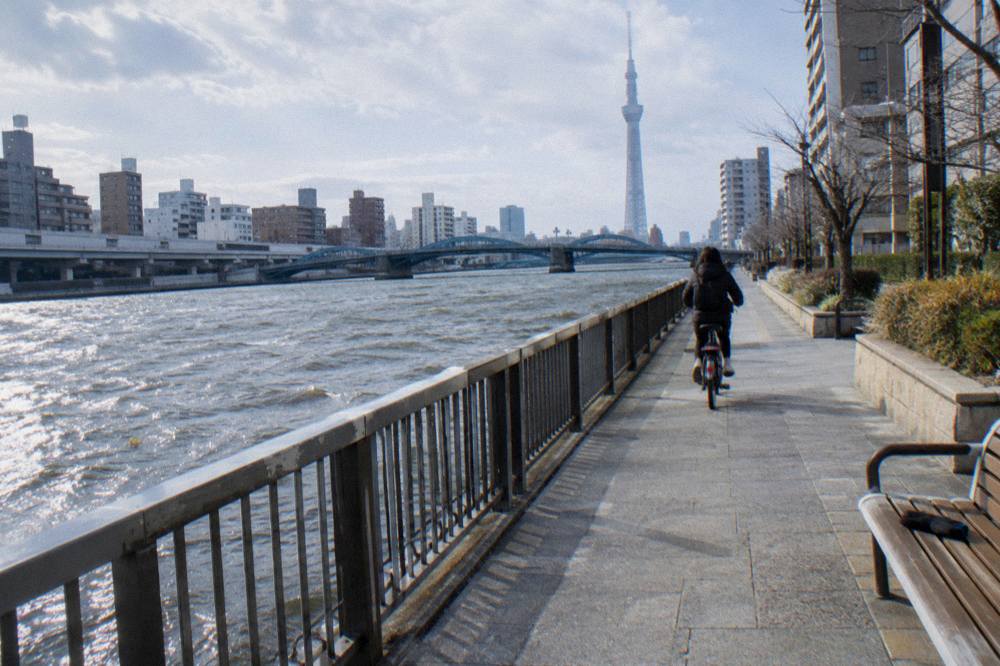
The guided case is equally real. A share bike drops you into the terrace-courtesy judgment calls alone, without the insurance a tour operator must carry for you, and without anyone telling you which bridge deck gives the Skytree frame. The 6-Hour Full City Ride from $97.17 per person, rated 4.9 across 842 reviews with a group cap of 12, is the mid-weight option, taking in Tsukiji, Zojo-ji, Roppongi, Aoyama Cemetery, Meiji Jingu and the Imperial Palace over six hours.
The river-specific e-bike loop remains the purest guided expression of the corridor, and its 3-hour format suits a morning.
The decision rule is simple. If your Tokyo days are short and you want the river's story told while you ride, book a guided loop, every option above carries free cancellation per its listing. If your days are long and your curiosity is wander-shaped, take a share bike, ride the Asakusa-to-Skytree stretch at your own pace, and let the river decide how far downstream you go. Whichever you choose, Tokyo Bike Tours exists to make that call an informed one.
Three picks to compare in one place, from the bay loop to the deep small-group day:
For riders whose appetite outgrows one river, the Tokyo cycling routes guide maps the longer corridors, including the Arakawa paths that route guides describe running far upstream of the city, and the bike tours in Japan guide widens the frame past Tokyo altogether.
Common Questions About Sumida River Cycling In Tokyo
Is The Sumida River Path Good For Beginner Cyclists?
Yes. The corridor is flat, the terraces separate riders from vehicle traffic, and the main skills needed are courtesy near pedestrians and modest bridge ramps. Guided options such as the Olympic Sites Bay Ride, 3 hours from $48.59 per person with bike, helmet and guide included, remove even the navigation work.
Can You Cycle From Asakusa To Skytree Along The River?
Route guides describe a riverside stretch of roughly 4 km from the Asakusa area downstream past Skytree, on terraces and quays with continuous water views. It is the densest sightseeing segment of any riverside ride in the city and takes well under an hour at touring pace.
Do You Need A Helmet To Cycle Along The Sumida In Tokyo?
Helmets are an effort obligation for every age since April 2023, meaning riders should wear one but face no fine. The Tokyo police report that 63.5 percent of cycling deaths in the city between 2021 and 2025 involved fatal head injuries. Most guided tours include a helmet; a few rent one for 1000 yen cash.
How Much Does A Guided Sumida-Area Bike Tour Cost?
From prices on the current options run from $48.59 per person for the 3-hour Olympic Sites Bay Ride, through $61.54 to $62.19 for 3-hour highlights loops, to $106.89 for the 6 hours 30 minutes small-group ride at 5.0 across 1,308 reviews. All are per person with the basis shown on each booking page.
When Is The Best Month To Ride The Sumida River?
Late March into April for the cherry blossom, with JMA normals putting Tokyo first bloom near 24 March and the 2026 bloom recorded on 19 March, or October into November for cool, dry conditions. September and October are statistically the wettest months at 224.9 mm and 234.8 mm, while winter is dry and bright.
Is It Better To Use Bike Share Or A Guided Tour On The River?
Bike share works well for the corridor: Docomo's official pricing starts at 165 yen per 30 minutes with a 1,650 yen day pass, though bikes must return to stations and registration needs a smartphone and credit card. A guided tour adds the legally required insurance coverage, helmet, route judgment and commentary, typically from $48.59 per person upward.